|
libpredict
1.0.0
A satellite orbit prediction library
|
|
libpredict
1.0.0
A satellite orbit prediction library
|
Satellite orbit definitions, according to defined NORAD TLE. More...
#include <predict.h>
Data Fields | |
| char | name [128] |
| Name of satellite. | |
| predict_julian_date_t | time |
| Timestamp for last call to orbit_predict. | |
| double | position [3] |
| ECI position in km. | |
| double | velocity [3] |
| ECI velocity in km/s. | |
| double | latitude |
| Latitude in radians, northing/easting. | |
| double | longitude |
| Longitude in radians, northing/easting. | |
| double | altitude |
| Altitude in km. | |
| int | eclipsed |
| Whether satellite is eclipsed by the earth. | |
| double | eclipse_depth |
| Eclipse depth. | |
| enum predict_ephemeris | ephemeris |
| Which perturbation model to use. | |
| char | line1 [70] |
| Original TLE line number one: | |
| char | line2 [70] |
| Original TLE line number two: | |
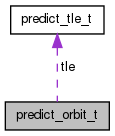
| predict_tle_t | tle |
| Original tle_t used to hold processed tle parameters used in calculations. | |
| int | catnum |
| Satellite number (line 1, field 2) | |
| long | setnum |
| Element number (line 1, field 13) | |
| char | designator [10] |
| International designator (line 1, fields 4, 5, 6) | |
| int | year |
| Epoch year (last two digits) (line 1, field 7) | |
| double | refepoch |
| Epoch day (day of year and fractional portion of day, line 1, field 8) | |
| double | incl |
| Inclination (line 2, field 3) | |
| double | raan |
| Right Ascension of the Ascending Node [Degrees] (line 2, field 4) | |
| double | eccn |
| Eccentricity (decimal point assumed) (line 2, field 5) | |
| double | argper |
| Argument of Perigee [Degrees] (line 2, field 6) | |
| double | meanan |
| Mean Anomaly [Degrees] (line 2, field 7) | |
| double | meanmo |
| Mean Motion [Revs per day] (line 2, field 8) | |
| double | drag |
| First Time Derivative of the Mean Motion divided by two (line 1, field 9) | |
| double | nddot6 |
| Second Time Derivative of Mean Motion divided by six (decimal point assumed, line 1, field 10) | |
| double | bstar |
| BSTAR drag term (decimal point assumed, line 1, field 11) | |
| int | orbitnum |
| Orbital number (line 2, field 9) | |
| void * | ephemeris_data |
| Ephemeris data structure pointer. | |
Satellite orbit definitions, according to defined NORAD TLE.
| double predict_orbit_t::altitude |
Altitude in km.
| double predict_orbit_t::argper |
Argument of Perigee [Degrees] (line 2, field 6)
| double predict_orbit_t::bstar |
BSTAR drag term (decimal point assumed, line 1, field 11)
Satellite number (line 1, field 2)
| char predict_orbit_t::designator[10] |
International designator (line 1, fields 4, 5, 6)
| double predict_orbit_t::drag |
First Time Derivative of the Mean Motion divided by two (line 1, field 9)
| double predict_orbit_t::eccn |
Eccentricity (decimal point assumed) (line 2, field 5)
Eclipse depth.
Whether satellite is eclipsed by the earth.
Which perturbation model to use.
Ephemeris data structure pointer.
| double predict_orbit_t::incl |
Inclination (line 2, field 3)
| double predict_orbit_t::latitude |
Latitude in radians, northing/easting.
| char predict_orbit_t::line1[70] |
Original TLE line number one:
| char predict_orbit_t::line2[70] |
Original TLE line number two:
| double predict_orbit_t::longitude |
Longitude in radians, northing/easting.
| double predict_orbit_t::meanan |
Mean Anomaly [Degrees] (line 2, field 7)
| double predict_orbit_t::meanmo |
Mean Motion [Revs per day] (line 2, field 8)
| char predict_orbit_t::name[128] |
Name of satellite.
| double predict_orbit_t::nddot6 |
Second Time Derivative of Mean Motion divided by six (decimal point assumed, line 1, field 10)
Orbital number (line 2, field 9)
| double predict_orbit_t::position[3] |
ECI position in km.
| double predict_orbit_t::raan |
Right Ascension of the Ascending Node [Degrees] (line 2, field 4)
| double predict_orbit_t::refepoch |
Epoch day (day of year and fractional portion of day, line 1, field 8)
Element number (line 1, field 13)
Timestamp for last call to orbit_predict.
Original tle_t used to hold processed tle parameters used in calculations.
| double predict_orbit_t::velocity[3] |
ECI velocity in km/s.
Epoch year (last two digits) (line 1, field 7)
 1.7.6.1

