planetiler
Planetiler
Planetiler (pla·nuh·tai·lr, formerly named “Flatmap”) is a tool that generates Vector Tiles from geographic data sources like OpenStreetMap. Planetiler aims to be fast and memory-efficient so that you can build a map of the world in a few hours on a single machine without any external tools or database.
Vector tiles contain raw point, line, and polygon geometries that clients like MapLibre can use to render custom maps in the browser, native apps, or on a server. Planetiler packages tiles into an MBTiles (sqlite) file that can be served using tools like TileServer GL or even queried directly from the browser. See awesome-vector-tiles for more projects that work with data in this format.
Planetiler works by mapping input elements to vector tile features, flattening them into a big list, then sorting by tile ID to group into tiles. See ARCHITECTURE.md for more details or this blog post for more of the backstory.
Demo exAmericana
See the live demo of vector tiles created by Planetiler and hosted by the OpenStreetMap Americana Project.
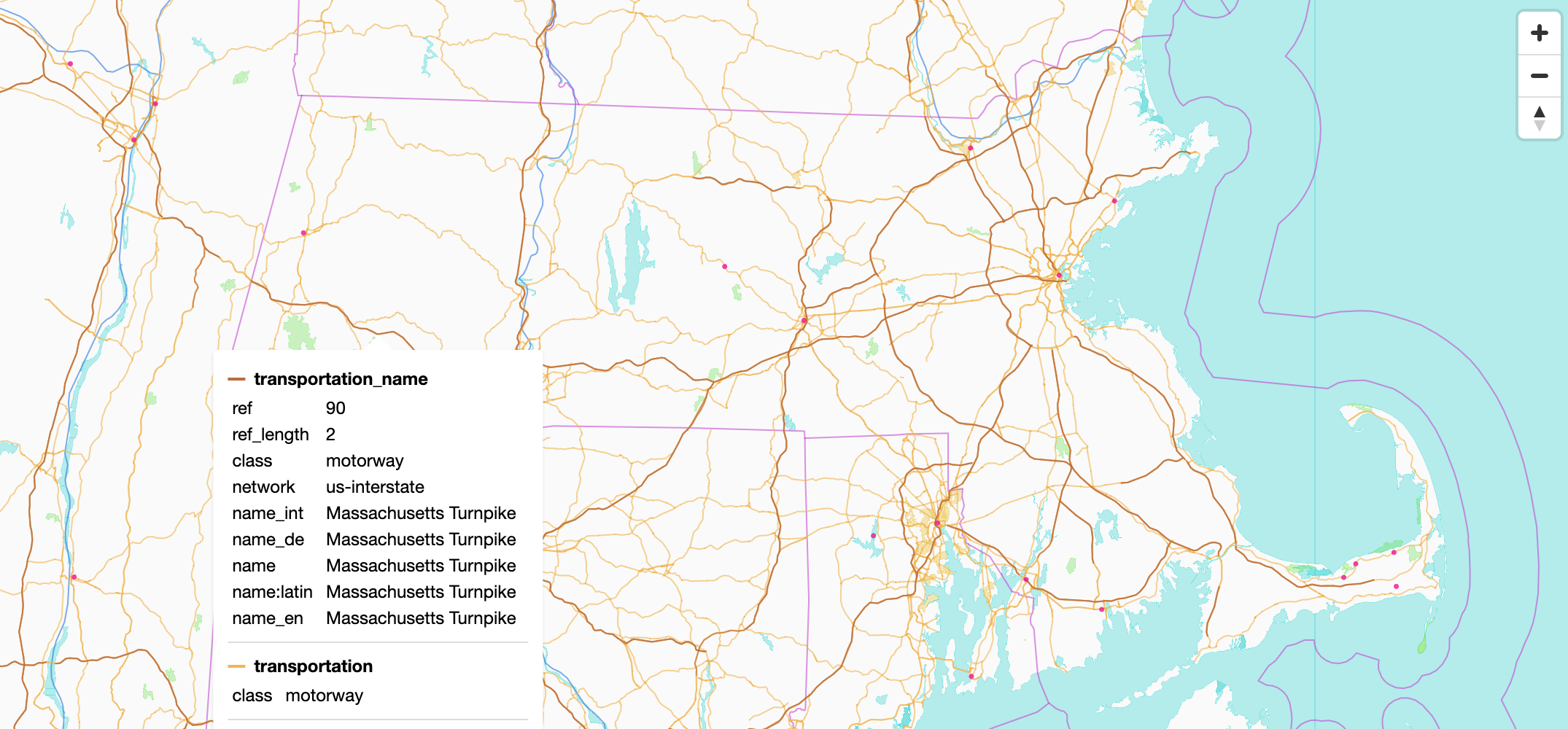 Style © OpenMapTiles
· Data © OpenStreetMap contributors
Style © OpenMapTiles
· Data © OpenStreetMap contributors
Usage
To generate a map of an area using the basemap profile, you will need:
- Java 16+ (see CONTRIBUTING.md) or Docker
- at least 1GB of free disk space plus 5-10x the size of the
.osm.pbffile - at least 0.5x as much free RAM as the input
.osm.pbffile size
To build the map:
Using Java, download planetiler.jar from
the latest release
and run it:
wget https://github.com/onthegomap/planetiler/releases/latest/download/planetiler.jar
java -Xmx1g -jar planetiler.jar --download --area=monaco
Or using Docker:
docker run -e JAVA_TOOL_OPTIONS="-Xmx1g" -v "$(pwd)/data":/data ghcr.io/onthegomap/planetiler:latest --download --area=monaco
:warning: This starts off by downloading about 1GB of data sources required by the basemap profile including ~750MB for ocean polygons and ~240MB for Natural Earth Data.
To download smaller extracts just for Monaco:
Java: ```bash java -Xmx1g -jar planetiler.jar --download --area=monaco \ --water-polygons-url=https://github.com/onthegomap/planetiler/raw/main/planetiler-core/src/test/resources/water-polygons-split-3857.zip \ --natural-earth-url=https://github.com/onthegomap/planetiler/raw/main/planetiler-core/src/test/resources/natural_earth_vector.sqlite.zip ``` Docker: ```bash docker run -e JAVA_TOOL_OPTIONS="-Xmx1g" -v "$(pwd)/data":/data ghcr.io/onthegomap/planetiler:latest --download --area=monaco \ --water-polygons-url=https://github.com/onthegomap/planetiler/raw/main/planetiler-core/src/test/resources/water-polygons-split-3857.zip \ --natural-earth-url=https://github.com/onthegomap/planetiler/raw/main/planetiler-core/src/test/resources/natural_earth_vector.sqlite.zip ``` You will need the full data sources to run anywhere besides Monaco.To view tiles locally:
Using Node.js:
npm install -g tileserver-gl-light
tileserver-gl-light --mbtiles data/output.mbtiles
Or using Docker:
docker run --rm -it -v "$(pwd)/data":/data -p 8080:8080 maptiler/tileserver-gl -p 8080
Then open http://localhost:8080 to view tiles.
Some common arguments:
--downloaddownloads input sources automatically and--only-downloadexits after downloading--area=monacodownloads a.osm.pbfextract from Geofabrik--osm-path=path/to/file.osm.pbfpoints Planetiler at an existing OSM extract on disk-Xmx1gcontrols how much RAM to give the JVM (recommended: 0.5x the input .osm.pbf file size to leave room for memory-mapped files)--forceoverwrites the output file--helpshows all of the options and exits
Generating a Map of the World
See PLANET.md.
Examples
See the planetiler-examples project.
Benchmarks
Some example runtimes for the Basemap OpenMapTiles-compatible profile (excluding downloading resources):
| Input | Version | Machine | Time | mbtiles size | Logs |
|---|---|---|---|---|---|
| s3://osm-pds/2022/planet-220530.osm.pbf (69GB) | 0.5.0 | c2d-standard-112 (112cpu/448GB) | 37m cpu:48h5m gc:3m45s avg:76.9 | 79GB | logs |
| s3://osm-pds/2022/planet-220530.osm.pbf (69GB) | 0.5.0 | c6gd.16xlarge (64cpu/128GB) | 53m cpu:41h58m avg:47.1 | 79GB | logs, VisualVM Profile |
| s3://osm-pds/2022/planet-220530.osm.pbf (69GB) | 0.5.0 | c6gd.8xlarge (32cpu/64GB) | 1h27m cpu:37h55m avg:26.1 | 79GB | logs |
| s3://osm-pds/2022/planet-220530.osm.pbf (69GB) | 0.5.0 | c6gd.4xlarge (16cpu/32GB) | 2h38m cpu:34h3m avg:12.9 | 79GB | logs |
| s3://osm-pds/2021/planet-211011.osm.pbf (65GB) | 0.1.0 | DO 16cpu 128GB | 3h9m cpu:42h1m avg:13.3 | 99GB | logs, VisualVM Profile |
| Daylight Distribution v1.6 with ML buildings and admin boundaries (67GB) | 0.1.0 | DO 16cpu 128GB | 3h13m cpu:43h40m avg:13.5 | 101GB | logs |
Merging nearby buildings at z13 is very expensive, when run with --building-merge-z13=false:
| Input | Version | Machine | Time | mbtiles size | Logs |
|---|---|---|---|---|---|
| s3://osm-pds/2022/planet-220530.osm.pbf (69GB) | 0.5.0 | c2d-standard-112 (112cpu/448GB) | 26m cpu:27h47m avg:63.9 | 79GB | logs |
| s3://osm-pds/2022/planet-220530.osm.pbf (69GB) | 0.5.0 | c6gd.16xlarge (64cpu/128GB) | 39m cpu:27h4m avg:42.1 | 79GB | logs, VisualVM Profile |
| s3://osm-pds/2021/planet-220214.osm.pbf (67GB) | 0.3.0 | r6g.16xlarge (64cpu/512GB) with ramdisk and write to EFS | 1h1m cpu:24h33m avg:24.3 | 104GB | logs |
| s3://osm-pds/2021/planet-211011.osm.pbf (65GB) | 0.1.0 | Linode 50cpu 128GB | 1h9m cpu:24h36m avg:21.2 | 97GB | logs, VisualVM Profile |
Alternatives
Some other tools that generate vector tiles from OpenStreetMap data:
- OpenMapTiles is the reference implementation of
the OpenMapTiles schema that the basemap profile is based
on. It uses an intermediate postgres database and operates in two modes:
- Import data into database (~1 day) then serve vector tiles directly from the database. Tile serving is slower and requires bigger machines, but lets you easily incorporate realtime updates
- Import data into database (~1 day) then pregenerate every tile for the planet into an mbtiles file which takes over 100 days or a cluster of machines, but then tiles can be served faster on smaller machines
- Tilemaker uses a similar approach to Planetiler (no intermediate database), is more mature, and has a convenient lua API for building custom profiles without recompiling the tool, but takes about a day to generate a map of the world
Some companies that generate and host tiles for you:
- Mapbox - data from the pioneer of vector tile technologies
- Maptiler - data from the creator of OpenMapTiles schema
- Stadia Maps - what onthegomap.com uses in production
If you want to host tiles yourself but have someone else generate them for you, those companies also offer plans to download regularly-updated tilesets.
Features
- Supports Natural Earth, OpenStreetMap .osm.pbf, and Esri Shapefiles data sources
- Java-based Profile API to customize how source elements map to vector tile features, and post-process generated tiles using JTS geometry utilities
- Merge nearby lines or polygons with the same tags before emitting vector tiles
- Automatically fixes self-intersecting polygons
- Built-in basemap profile based on OpenMapTiles v3.13.1
- Optionally download additional name translations for elements from Wikidata
- Export real-time stats to a prometheus push gateway using
--pushgateway=http://user:password@ipargument (and a grafana dashboard for viewing) - Automatically downloads region extracts from Geofabrik
using
geofabrik:australiashortcut as a source URL - Unit-test profiles to verify mapping logic, or integration-test to verify the actual contents of a generated mbtiles file (example)
Limitations
- It is harder to join and group data than when using database. Planetiler automatically groups features into tiles, so you can easily post-process nearby features in the same tile before emitting, but if you want to group or join across features in different tiles, then you must explicitly store data when processing a feature to use with later features or store features and defer processing until an input source is finished (boundary layer example)
- Planetiler only does full imports from
.osm.pbfsnapshots, there is no way to incorporate real-time updates.
Use as a library
Planetiler can be used as a maven-style dependency in a Java project using the settings below:
Maven
Add this dependency to your java project:
<dependency>
  <groupId>com.onthegomap.planetiler</groupId>
  <artifactId>planetiler-core</artifactId>
  <version>0.5.0</version>
</dependency>
Gradle
Set up your repositories block as follows:
mavenCentral()
maven {
    url "https://repo.osgeo.org/repository/release/"
}
Set up your dependencies block as follows:
implementation 'com.onthegomap.planetiler:planetiler-core:<version>'
Contributing
Pull requests are welcome! See CONTRIBUTING.md for details.
Support
For general questions, check out the #planetiler channel on OSM-US Slack (get an invite here), or start a GitHub discussion.
Found a bug or have a feature request? Open a GitHub issue to report.
This is a side project, so support is limited. If you have the time and ability, feel free to open a pull request to fix issues or implement new features.
Acknowledgement
Planetiler is made possible by these awesome open source projects:
- OpenMapTiles for the schema and reference implementation that the basemap profile is based on
- Graphhopper for basis of utilities to process OpenStreetMap data in Java
- JTS Topology Suite for working with vector geometries
- Geotools for shapefile processing
- SQLite JDBC Driver for reading Natural Earth data and writing MBTiles files
- MessagePack for compact binary encoding of intermediate map features
- geojson-vt for the basis of the stripe clipping algorithm that planetiler uses to slice geometries into tiles
- java-vector-tile for the basis of the vector tile encoder
- imposm3 for the basis of OSM multipolygon processing and tag parsing utilities
- HPPC for high-performance primitive Java collections
- Osmosis for Java utilities to parse OpenStreetMap data
- JNR-FFI for utilities to access low-level system utilities to improve memory-mapped file performance.
See NOTICE.md for a full list and license details.
Author
Planetiler was created by Michael Barry for future use generating custom basemaps or overlays for On The Go Map.
License and Attribution
Planetiler source code is licensed under the Apache 2.0 License, so it can be used and modified in commercial or other open source projects according to the license guidelines.
Maps built using planetiler do not require any special attribution, but the data or schema used might. Any maps generated from OpenStreetMap data must visibly credit OpenStreetMap contributors. Any map generated with the profile based on OpenMapTiles or a derivative must visibly credit OpenMapTiles as well.